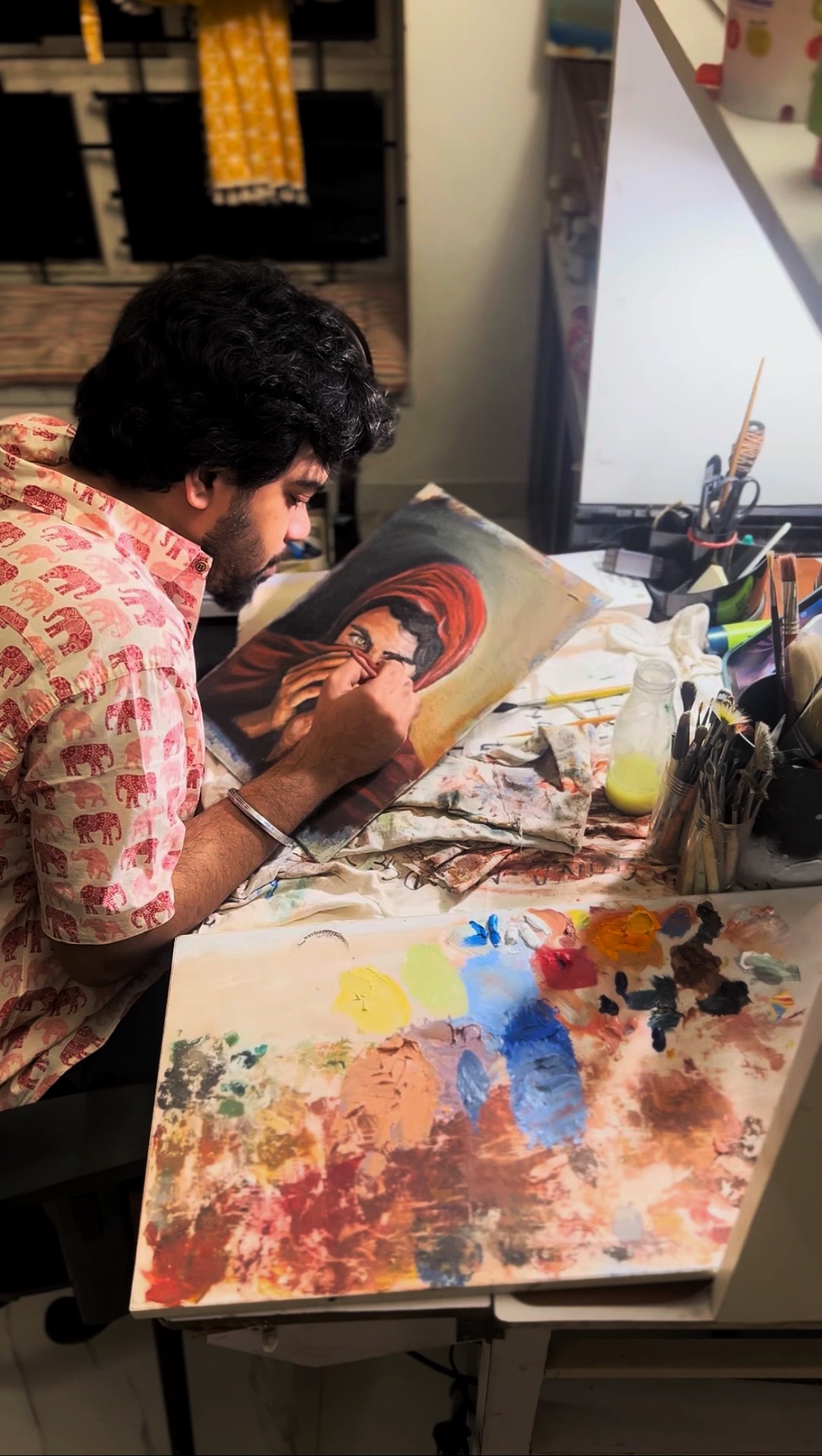
The Artist's Profile
There is a story Soham Ghosh does not tell often, though it explains nearly everything. He was thirteen, perhaps fourteen, when he walked onto a stage in Kolkata and handed a painting — four feet by four feet, stretched on canvas — to the man whose face was on it. The former President of India, A.P.J. Abdul Kalam, received it with the kind of warmth that great men sometimes have in private, the warmth that rooms rarely see. One of the painted eyes bulged slightly, almost alive, almost reaching out. Kalam looked at it. Soham, young and astonished, understood something in that moment that he would spend the next two decades trying to say in paint: that the feeling of a thing matters more than its accurate description.
His grandfather had a small collection of words he returned to, the way a river returns to its own banks. The light and shadow is what defines the composition, he would say — and the composition is what defines the light and shadow. You cannot do one without the other. A paradox, spoken plainly, repeated until it stopped sounding like one. The boy listened until he stopped hearing the words and started seeing what they meant — until the world arranged itself, without his asking, into forms in tension, into compositions that wanted to be looked at. This is how certain kinds of knowledge enter us: not as instruction, but as quiet repetition, until one day we look up and realise we have been changed.
Soham works in painting and photography, and he is careful to say they are not the same impulse wearing different clothes. Photography, for him, is the practice of finding composition in the ordinary — the daily act of learning to see. Painting is something else: it is the practice of finding magic in the ordinary. The distinction is real. One is discipline. The other is devotion.
He went once to Sandakphu, high in the mountains, and saw a sleeping Buddha. He did not paint it then. He carried it back with him — the altitude, the stillness, the particular quality of that silence — and two or three years later, set it down on canvas. The painting that emerged is not a record of what was there. It is a record of what it felt like to have been there, which is an entirely different thing, and a much harder one to achieve. The logistics — the exact angle of a hand, the precise colour of stone — these he let go. What he kept was the feeling of the position he had stood in: a man alone with something ancient, in thin air, trying to understand.
He lives in Kolkata, and the city lives in him in ways he finds difficult to name. Not in its images — not the peeling plaster, not the yellow taxis, not the specific weight of its monsoons. What Kolkata has given him is its rhythm: slow, unhurried, certain that whatever is worth doing will take as long as it takes. His paintings are rarely finished quickly. They resist the pressure of conclusion. In this, they are unmistakably from here.
There is a day job. He leads a team of engineers building software systems, a world of mechanical precision and defined deliverables, a world where feelings are, by design, beside the point. He does not say this bitterly. He says it with the clarity of a man who has understood exactly what the friction is for: the resistance of that life is what keeps his hands moving toward paint. The suppression is the fuel. He makes art, he says, so that people can feel a little better — and in doing so, he feels better too. It is not a complicated equation. It is, perhaps, the only honest one.
His mother once retrieved a drawing from the discard pile — one of dozens he had abandoned — and framed it quietly. He saw it later on the wall and felt something he found hard to articulate: that the frame had done something to the drawing that he himself had not managed to do. He has been thinking about that ever since. About what it means for a work to be seen. About the gap between what the maker feels and what the viewer receives. About the strange generosity of the act of looking.
Stand in front of one of his paintings long enough and something will happen. He cannot tell you what — it will depend on who you are, what you have carried with you into the room, what you have been trying not to feel. What he can tell you is that the painting will not explain itself. It will not resolve. It will stay open, the way a question stays open when it is the right one, and it will make a small, unfamiliar space inside you where something new can move.
That is what he has always been making. Not pictures. Spaces.
Soham Ghosh lives and works in Kolkata, India.